
Unbound Unfiltered
Our Mechanic’s Dispatch from the Pits

As redoubtable a race as Unbound always is, the 2026 edition proved to be among the most arduous in the event’s long history, with appalling superstorms causing havoc, breaking equipment and spirits. Factor Racing athletes were spread out between Unbound XL and Unbound 200, with Victor Bosoni and Rob Britton tackling the XL, while Romain Bardet, Haley Hunter (26th), Nicole Frain, Hayley Preen (8th), Magnus Bak, and Gustav Orain looked to conquer the 200.
Factor had a support crew on the ground to help at each aid station. Cole Weldon, Factor Tech Manager, was among the crew to offer morale support and assistance as an expert mechanic. This is his story of a day where the support staff suffers only a little less from the conditions than the athletes forced to forge newly-formed rivers and withstand the enveloping nature of Kansas’ peanut butter mud.

A muddy and gruelling Unbound 2026 has come and gone, not unlike the fast-paced storms that affected so many this past weekend. It was one for the history books, as reportage and images continue to flood social media streams, quite literally like the floods in far-off Kansas plains. I’m sure you were all taken aback by professionals and amateurs alike enduring harrowing conditions. I know I was.
As a mechanic, what occurred are the kind of conditions we dread: bikes destroyed, spirits crushed, dreams lost. All you can hope for is survival. Survival of the equipment, survival of the athletes, survival of the spirit. This idea of survival, the state of continuing to live or exist in spite of difficult conditions, danger, or adversity, has been rolling around in my head as I headed home from the event. It’s an idea worth exploring from my experience. Let’s recap SURVIVING Unbound.
Bleeding Kansas
Emporia, Kansas, a town of approximately 24,000 people, once better known as a notable railroad hub in a bygone era of US exceptionalism, is an otherwise sleepy town. But come the weekend of Unbound, it explodes with hopeful energy as thousands of cyclists descend on the city looking to challenge themselves against the difficult conditions and adversity the race is known for. Perhaps even looking forward to some danger (a quality we know now wouldn’t be missed), all to survive.
Driving into town two days before the race on Saturday, I was struck by the prairie landscape that characterises the course. Vast, rolling hills stretch to the horizon, punctuated by grazing cattle, already darkened by distant storm clouds, lending a marbled texture to the sky. Lightning strikes and wet fields indicated conditions were going to be difficult. If being on the ground wasn’t already proof enough, every forecast available was stating the obvious. How would those caught in these conditions hope to survive, I wondered?

Surviving looks a little different for all parties involved. The pros, of course, have the toughest task, because aside from a personal stockpile of hydration and carbohydrates during an event like Unbound, they are mostly left to fend for themselves while on course. In the hunt for efficiency and speed, they forgo excess materials, leaving behind common-sense measures for amateurs like rain jackets, while riding fragile machines hyper-optimised for this event in hopes of the win or at least to survive to the finish. For mechanics, we are afforded a few more creature comforts; our tools and sensible gear allow us to put aside our personal concerns and focus solely on ensuring the pros survive. Think of it as a symbiotic relationship where mechanics provide the foundation of a Maslow hierarchy for pros to find themselves at the top, accomplishing self-actualisation - i.e., WINNING or, considering this edition of Unbound, SURVIVING.

RACE DAY
4:30 a.m. wake-up call. An ungodly hour to be awake, but we’re here, and it’s a big day for us. Reports were already coming in that the pros in the XL were having a hell of a time. DNFs throughout the night due to the worst storm cells that made their way across the plains and left most riders dealing with insurmountable odds. A worrying sign to be sure.
AID STATION 1
8:00 a.m. - Amongst the support staff and myself, we decided to employ a divide-and-conquer approach by leapfrogging one another to the different aid stations, ensuring a punctual arrival in anticipation of Haley, Nicole, and Gustav. Aid Station 1 went smoothly by all accounts, promising even. Despite some initial muddy conditions, the pro field for both the women and men came in fast. Handoffs were obtained by all our riders, and the race carried on. Overall, Aid Station 1 was a success. Exactly what mechanics want to see. Some might say excitement is desirable, but for us, boredom is a luxury.

AID STATION 2
10:00 a.m. - The pro field begins trickling into Aid Station 2. In years past, when conditions were dry, the feed zone was chaotic, since modern gravel racing is approaching average speeds you would expect to see during a road race. Support staff and mechanics often scramble, as it isn’t unusual for a 20-plus bunch to come through the feed zone at one time. Confusion abounds, given the less-than-clear roles and expectations of the privateer system versus the well-oiled machine one sees in a professional road outfit.

This time, however, storms surround us all along the horizon; rain, lightning and mud are apparent. The procession is more solemn, as the pros pedal into the feed zone one at a time with looks of discouragement more akin to a funerary march than a bike race; being caked in thick muck only adds to the humiliation. Minimal bunches and relatively low speeds this early show the course is prematurely impacting morale and equipment. Survival will be difficult.
Haley enters the pit. While we are able to secure her feed and hydration efficiently according to the plan we established days before, she confirms that the conditions are already negatively impacting her. We offer words of encouragement to help her survive through the mess, but we know it's up to her to push through and that it likely won’t get easier.
Next, Gustav enters the pit. The course is beginning to take its toll. His equipment and face show it all. Once again, the handoffs go smoothly, but the rest of the race is only going to get harder.
Proving as much, we received communication that Nicole had unfortunately crashed before Aid Station 2. It was even captured on the live feed to our shock. We prepared as much for the worst. This is the kind of excitement mechanics do not look forward to. We’re in the dark about what to expect; you have to be ready for anything. By some miracle, despite what we saw, she was persevering. Running on survival instinct for sure. Sadly, this would not last.

AID STATION 3
1:00 p.m. - Transferring to Aid Station 3, the reality of the race quickly settled in: survival is all that most can hope for. While not under our direct support, we found out that fellow Factor Racing athlete Romain Bardet had abandoned the race. Enduring the conditions isn't worth it; better to survive than continue to break yourself. Storm activity increases all around us. We receive a distressing message from Gustav that he is limping into the aid station at this point. Caught in a vicious storm cell, traversing knee-deep water crossings with no visibility, he can only hope to make it to the oasis that is the final aid station.

Bad news continues to trickle in. We learn Nicole had abandoned as well.
We finally arrive and set up our equipment in anticipation of what's next. Pros eke by mostly one at a time. Some managed to crack a smile in spite of the absurdity of the situation, but most looked as though they had gotten back from the trenches: shell-shocked, traumatised.
Haley arrives. As testament to her willingness to survive, she simply asks for a musette and pushes on to the finish.
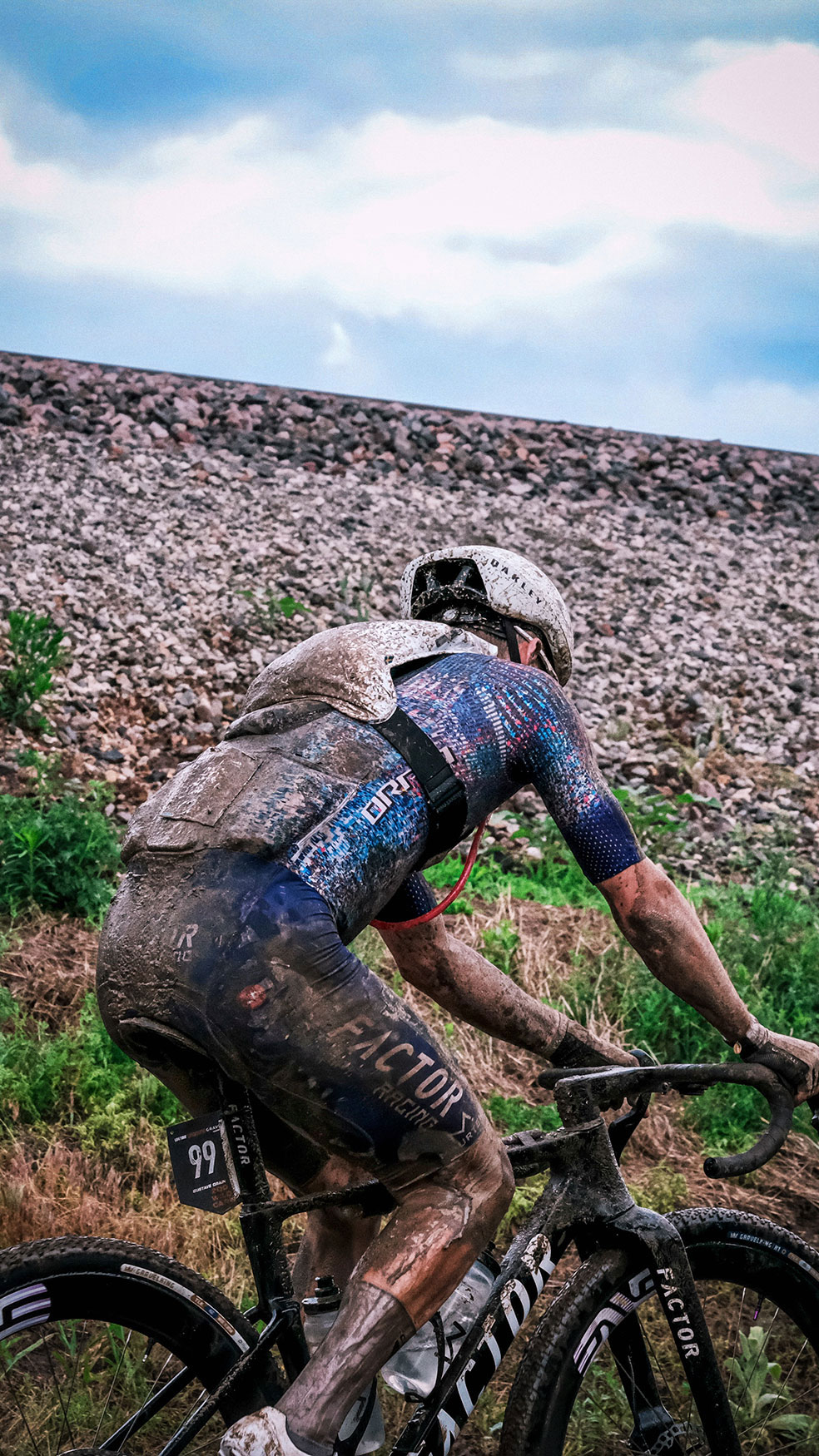
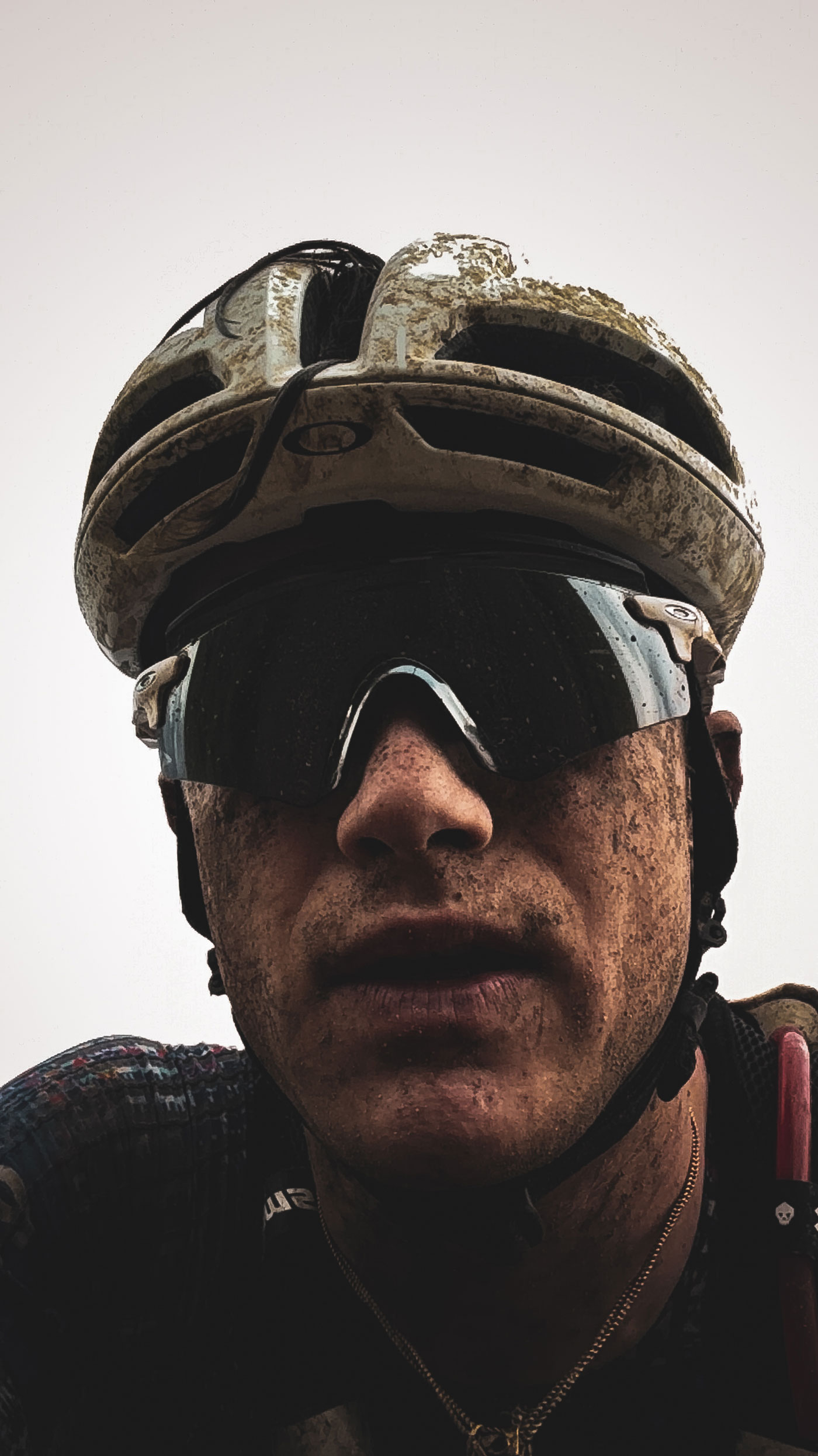
Concluding the struggle, Gustav arrives absolutely annihilated by the course. The amount of mud, dirt, and sand enveloping him was akin to a plaster-of-paris he could only hope to later break free from. He and his bike are unrecognisable. He dismounts and drops to the ground. That's it. The day is done. Better to survive.
Respite
5:00 p.m. - The storms have since passed. You'd be fooled to believe it was just any other day; the sun is out, roads are dry. Luxurious boredom sets in; dreadful excitement is a distant memory, the kind of thing a mechanic appreciates. We are tired, battered, and hungry. Perhaps as an inside joke to ourselves, or to cap off the absurdity of the muddy and gruelling day in Emporia, Kansas, the support staff, myself, and Gustav decided to visit an Applebee's for a quiet dinner. Maybe not the classiest choice, but appropriate when trudging the back roads of middle America. We order fried mozzarella sticks, offer them to Gustav, and cheers one another, grateful we have all SURVIVED Unbound.
A Factor Postscript
It’s generally acknowledged in professional cycling circles that the hardest working members of any team are always the mechanics. They always are the first up and the last to bed.
A quiet illustration of this comes as an appropriate postscript to Cole’s amazing account of his day at Unbound. After the impromptu Applebee's dinner, Cole’s day was far from finished. Factor Racing’s Victor Bosoni was scheduled to fly to Calgary the next day to prepare for racing at the Tour Divide, but his SARANA required tons of TLC before Victor would be able to race it in the Rockies.
That meant that Cole needed to spend Saturday evening with Victor's battle-worn SARANA, rebuilding it, replacing a suspension fork, and generally getting it back in mint condition for the Tour Divide, Victor’s next big goal. Though Cole may have been too modest to mention that in his recap, we believe it is a prime example of how hardworking and humble mechanics are. They keep the wheels turning and are great ambassadors for what makes cycling so special.
Follow us for the latest updates from all our athletes.


© 2026 Factor Bikes. All rights reserved / Privacy Policy |Terms